Billboards vs. offramps: Rethinking brand visibility for AI search
Search isn’t disappearing, but AI is changing how people discover brands.
For years, search strategy focused on capturing intent and driving traffic to a website, while brand awareness was shaped through PR, social media, advertising, thought leadership, and other channels. AI search is bringing those once-separate functions together within the same experience.
Today, users can ask AI tools complex questions and receive synthesized answers without ever clicking through to a website. Discovery, evaluation, and decision-making can now happen within the same interaction.
At Quietly, we often explain this shift using a simple mental model: the AI Search Highway.

Imagine every AI search as a highway. The model consists of three parts:
- Traffic flow: The prompts, questions, and demand signals moving through AI systems every day.
- Billboards: The brands, ideas, and sources that appear within AI-generated answers through mentions, citations, and summarized insights.
- Off-ramps: The moments when users leave the AI environment to visit a website, search for a company directly, or take another action.
Historically, marketers focused on the off-ramp. Success was measured through rankings, clicks, and website traffic. The assumption was straightforward: if users arrived on your site, you had an opportunity to influence their decision. AI search introduces a different dynamic.
According to Bain & Company, roughly 60 percent of searches now end without a click to another website. As AI-generated answers become more common, discovery increasingly happens before a user ever reaches a destination. That changes the strategic objective. Brands are no longer competing solely for the click; they’re competing to be visible before the click happens.
When someone asks an AI platform for recommendations, comparisons, industry insights, or best practices, the brands that appear in the answer immediately enter the conversation. The brands that don’t appear may never enter the consideration set at all. Visibility has always mattered. AI search simply makes its importance more obvious.
The off-ramp is becoming less predictable
Being visible on the highway doesn’t guarantee that someone will take the off-ramp.
AI systems form an understanding of a brand from information distributed across the web, including what a company publishes about itself and how others discuss it. As a result, visibility is shaped across SEO, communications, brand, thought leadership, and content—not just on a company’s website.
The path from that visibility to action is also becoming harder to trace. Some users will click through immediately. Others may search for a brand later, visit directly, or continue gathering information without ever reaching the company’s website.
This gives marketing leaders a broader set of questions to consider:
- What demand signals are emerging in prompts and conversations?
- Is our brand being surfaced, cited, or referenced in AI-generated responses?
- What information is shaping how AI systems understand our category?
- When users leave AI platforms, how are they finding us?
When share of voice becomes share of memory
Appearing on the billboard is only part of the challenge. The more important question is whether anyone remembers you after they’ve passed it.
A useful example comes from Burma-Shave, a shaving company that became famous for a series of roadside billboards spread across American highways. Rather than delivering a single message, the brand used multiple signs to tell a story, creating an experience drivers anticipated and remembered long after their journey ended.
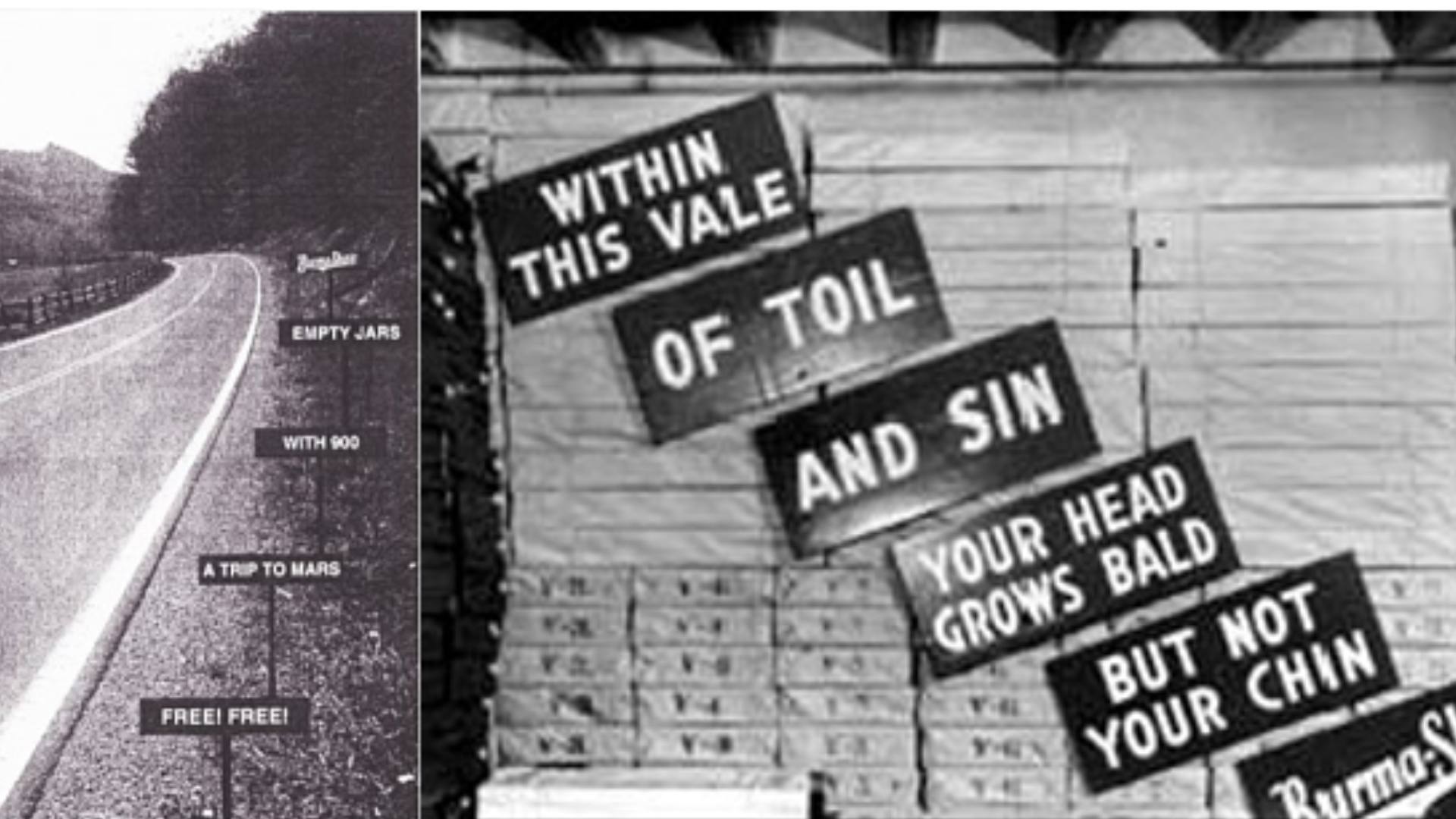
Burma Shave’s roadside billboards only contained a few words, but together, they built an ad that’s still referenced almost a century later. Source: MediaVillage
The campaign worked because it was distinctive. The same principle applies to AI search.
As AI-generated answers become increasingly crowded with brands, recommendations, and sources, simply being present won’t be enough. Brands need to contribute ideas that are recognizable, memorable, and easy to retrieve later.
This is where share of memory becomes important. Organizations that consistently stand out in AI-driven discovery tend to contribute perspectives that are difficult to confuse with anyone else’s. They publish original research, develop proprietary frameworks, introduce memorable mental models, and take informed positions on industry trends. Over time, those ideas become associated with the brand itself.
Distinctiveness doesn’t replace relevance. Brands still need to answer the questions their audiences are asking, but doing so with a recognizable point of view makes those ideas easier to remember and associate with the brand.
Building visibility beyond your website
The highway framework also changes how marketers should think about where brand visibility is built. If AI systems are drawing on signals from across the web, the work can’t sit within SEO or owned content alone. Content, communications, thought leadership, brand, and other channels all contribute to how a company is represented and remembered.
Prompt mapping can help teams understand the questions and conversations that matter most and use those insights across the organization. Brands can then build visibility over time by consistently contributing useful, distinctive ideas wherever their audiences are looking for answers.
The future of the search economy
If AI answers function like billboards on the information highway, the advertising implications are already taking shape. Advertising has begun moving into AI-driven discovery environments, with platforms introducing and testing sponsored placements designed to reach users as they explore, compare, and make decisions.
Exactly how these advertising models evolve remains to be seen, but the broader pattern is familiar: when attention concentrates in a discovery platform, monetization follows.
“I always say as a company, you either die or you live long enough to become an ads company. And so we are seeing now with OpenAI, it’s happening. These are natural language queries ripe for amazing, amazing targeting. [But] you have to be the first party…drive outcomes…[and] be exclusive.” – Gokul Rajaram, Founder, Marathon Management
Paid placements add another layer of competition for attention within AI-driven discovery. For brands, though, the bigger question is where influence is created.
For years, the value of search was tied primarily to the moment a user clicked through to a website. Increasingly, influence begins earlier, inside the answers that shape awareness, consideration, and preference before any click occurs.
Brands need to think about visibility as more than a traffic acquisition strategy, including how they are represented, remembered, and discussed across the broader information ecosystem.
Because in the age of AI search, influence starts on the highway, not at the off-ramp.
This framework comes from Quietly’s work helping brands adapt their content, brand, and visibility strategies for AI-mediated discovery. It’s based on recurring patterns we see across client engagements, public platform behavior, and third-party research on how users interact with AI-generated answers.