Content consistency & breaking the AI visibility code
______________________________________________________________________________________________________
- AI visibility starts with reinforced principles and language.
- Consistency isn’t only rooted in messaging — it also shows up in your workflows, guidelines, approvals, training, planning, and cross-functional collaboration.
- Marketing systems that repeatedly produce recognizable, credible answers will likely be cited more over those facing interpretive drift.
______________________________________________________________________________________________________
For years, content consistency was viewed as a fundamental brand principle: when audiences encountered the same idea, expressed in a recognizable way, across multiple moments, it made your brand easier to remember, choose, and believe. The premise is still true. Yet somewhere along the way, businesses forgot about being memorable and focused more on becoming measurable.
And now, there’s added pressure because your audience isn’t the only one looking for consistency anymore. When assessing your brand, AI systems leverage numerous signals — your content, social posts, third-party mentions, product pages, etc. — to determine what it actually means. And its key indicator? Consistency.
When it comes to visibility, consistency is the number one indicator. To get there, marketing leaders need reduce the risk of interpretive drift within their teams first, beginning with communication.
The power of alignment on consistent content performance
In traditional search and social outlets, interpretive drift wasn’t as impactful. A campaign could still rank, a post could gain impressions, and a page could convert without majorly affecting organic traffic. All of that changed with AI. You may have the right documentation in place, but when team members aren’t aligned on your core brand messaging, that drift eventually transforms into inconsistency.
Think of alignment as your internal team-facing driver and consistency as the external output AI sees. While product tries to define the offer accurately, content works to make it compelling, and sales optimizes it to be usable in conversation. Individually, none of these shifts feel like a contradiction — they may even feel like healthy customization. Across the system, however, they create competing interpretations.
When the same idea appears across your ecosystem with different definitions, claims, or levels of specificity, AI has to infer whether those pieces are supporting the same message or introducing separate ones. This is why one asset may rank while another disappears, or why a weak answer may be cited while a stronger one gets ignored.
Humans can make the ambiguity manageable. AI doesn’t have that advantage. It reads the content system as it exists. None of this means teams should flatten every message into identical language. Brand messaging should be altered based on the audience, channel, and moment. However, the meaning has to remain consistent. If you lack internal alignment, your consistency, and thus visibility, is sure to suffer.
What makes an answer visible?
For AI to surface an answer, the system around it has to make it easy to understand, trust, distinguish, and connect back to the brand. That calls for more than a powerful piece of content. Instead of asking, “Do we have existing work on this topic?”, enterprises should focus on, “Can this hold up across the places AI is likely to find it?”
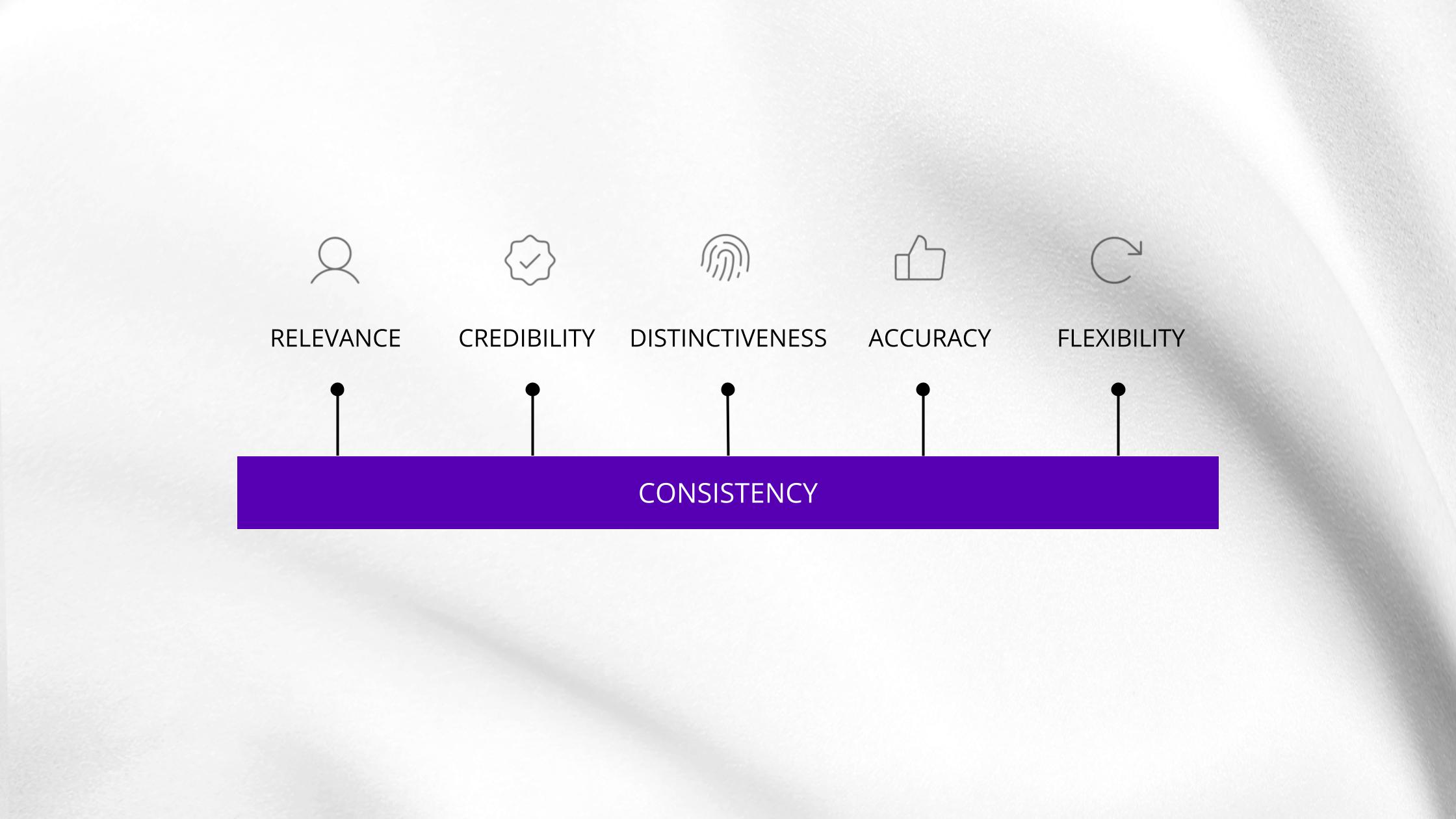
The key factors for consistency include relevance, credibility, distinctiveness, accuracy, and flexibility. Together, these principles can help you increase your AI visibility.
That means evaluating a few connected conditions:
- Relevance: Knowing your audience means knowing what content will resonate with them.
- Credibility: Ensuring you have the proof-points to substantiate your perspective will help build authority.
- Distinctiveness: AI needs a reason to connect your messaging to your brand. If your voice sounds like everyone else’s, even a consistent claim becomes invisible.
- Accuracy: Teams reorganize, products evolve, campaigns launch, and priorities move. Your messaging should remain up-to-date and accurate as your company, industry, and technologies shift.
- Flexibility: All responses need to flex across formats, teams, and moments without becoming a different idea.
Every marketer recognizes these principles; AI doesn’t make them new — it makes them more operationally urgent. This isn’t a checklist for a single asset. Rather, it’s a way to assess whether your content ladders back to the same source of truth. And that requires you to look at the system through the same questions AI is implicitly trying to answer.
Is your idea relevant to the audience?
An idea is relevant to the audience when they have a reason to care. It may sound obvious, but it’s where many systems start to drift. Teams often create written copy around what the company wants to explain: a product capability, a market position, a new offer, a strategic priority. Although, if it doesn’t map to a real audience need or elicit a response, you’re giving AI little reason to retrieve it.
Like any good marketing copy, your responses should reflect the audience’s language, the tension they’re experiencing, and the decision they’re trying to make. Always look beyond whether a topic appears in the calendar and instead, whether the system has clearly defined the audience problem behind it.
- What is the audience actually asking?
- What do they need to understand before they can move forward?
- What misconception needs to be corrected?
- What decision are they trying to make?
- What would make this claim more useful than the version they could get from anyone else?
Without this pre-context, content ends up feeling aligned internally, yet remains disconnected from audience demand. AI systems are designed to satisfy the user’s query, not the brand’s publishing plan.
If another source provides a clearer, more useful, directly targeted response, it’ll favour it. Don’t think that every answer needs to be simplified into generic advice — in many cases, the most valuable response adds nuance — though the usefulness has to be legible, easy to identify, and easy to extract. Because when the audience can’t see the relevance, AI won’t treat the answer as valuable either.
Is your brand credible enough to own it?
Multiple companies can explain a trend, name the pain point, or offer a perspective on what should happen next. So can AI. The harder question is why one source should be trusted over another. Think of iconic brands: Coca-Cola, DoorDash, Adobe, Okta. Now imagine what it would be like if Coca-Cola started talking about the benefits of drinking Coke while managing AI risk. Even if the piece is well written and the argument is valid, the association would feel off.
Credibility gives your claim weight because you’ve earned the right to participate in and shape the conversation. Like how audiences rely heavily on user reviews, AI leans more towards claims supported by experience, evidence, third-party validation, and repeated use. You can’t depend on assertion alone.
To establish credibility, look into:
- Original research
- Client work
- Customer stories
- Media mentions
- Analyst references
- Social discussions and collaborations
Owned content can define the answer. Earned media has to help reinforce it. Ask yourself why the market should trust you, where you’ve demonstrated your claim previously, and whether the rest of your system can substantiate it. With this insight, you can avoid generic authority. Many brands can sound informed; fewer can show why their perspective is grounded in something specific, earned, and useful.
Is your answer meaningfully different from everyone else’s?
Just as vital as credibility is distinctiveness. You can have authority, but if your piece sounds like every other article, it’ll be ignored. Take an audit and assess whether it reflects a real point of view.
- Does it show how our brand sees the problem?
- Does it reveal what we believe others are missing?
- Can it connect to a perspective the company can credibly defend?
When you focus on reflecting common language or simplifying claims solely to avoid looking bad, your answer turns out polished and safe, which can easily flatten the signal. Consider how you roll your eyes when you see a piece of content that says “drive efficiency”, “improve experiences”, or “meet customers where they are”.
The truth is, AI does too. Only it’s not as nice about it. Always approach every general conversation with an innovative thought and build out from there. Once you have the angle, colour it with your brand voice — not for decoration, but to preserve distinction as the idea moves through your business. The more distinct your interpretation is, the easier it becomes for both audiences and AI systems to understand why the argument should be associated with you.
Does your answer remain accurate as the system changes?
Things change, especially in marketing. Whether it’s a re-org, product launch, or new team members with new priorities, it’s not unusual to experience shifts. Typically, your system will evolve as your business does. The risk comes when it grows without reconciling what came before. A company may update its positioning, but leave older blog posts built around the previous narrative; or a thought-leadership series may introduce a sharper point of view, while partner pages, case studies, and archived content continue to reinforce a softer one.
Human readers can put rationale behind the changes, where AI systems require context generated by your system. If it doesn’t have it, it’ll resort to reconciling your claim by pulling both old and new signals and treating old, new, and third-party assets as part of the same evidence set. When undergoing any major company changes, take a closer look at your overall messaging to make sure it’s still accurate by asking:
- Where are old and new versions of our message co-existing?
- Which assets still reflect a previous strategy?
- Does new content build on the answer we want to own, or reset it?
- Are third-party mentions reinforcing the current interpretation, or preserving an older one?
- When the business evolves, do teams know what needs to change and what remains the same?
Publishing without reconciliation creates signals that don’t resonate in AI systems. Although it has more to read, there’s less to rely on. These questions support your journey by making you pause and redefine processes for retiring old interpretations, updating foundational assets, and training teams on new language. A strong argument becomes more useful over time with each asset adding proof, depth, specificity, clarity, or reinforcement. Your system becomes more valuable when those arguments compound.
Can your answer flex across teams and priorities?
Flexibility is the point where your answer is either reinforced or fragmented. As we mentioned in the beginning, consistency is linked to preservation. You can have all the guidelines, processes, and workflows in the world, yet when messaging shifts across teams, channels, formats, and moments, it’s harder to recognize. No single asset is wrong. They’re competing.
By defining which claims are closest to the brand’s position, which terms teams use consistently, and which messages you can flex, you control what stays stable and relevant for AI systems. Now, this doesn’t mean that teams need to say the exact same sentence in every channel. In fact, they shouldn’t — a sales conversation should sound different from a thought-leadership article versus a product page or a customer story.
Nevertheless, to truly stand out in AI systems, teams must contribute to and align on the meaning behind the work before adapting it for their own channels. When teams share that standard, content becomes easier for audiences to understand and easier for AI to connect.
Reworking your content strategy for content consistency
AI is changing the way businesses frame their strategy by forcing marketing leaders to revisit the basics. Only now, those basics need to be operationalized and show up in workflows, guidelines, approvals, training, planning, and cross-functional collaboration. However, this exercise only becomes useful when teams come together to compare interpretations, resolve conflicts, and agree on what the brand’s claim needs to be.
Technical and structural hygiene, like schema, FAQs, page structure, internal linking, and clean information architecture can help AI access the answer — except they can’t compensate for an answer that’s unclear, unsupported, generic, or inconsistent. We’re not looking to create more rules; we’re seeking to build a system where your brand remains recognizable wherever it appears.
The way ahead
Content consistency is both a brand concern and a visibility requirement. The hack to AI visibility is knowing that it won’t repair itself overnight. The work is continuous at both the generation and system levels. It’s no longer whether your work is good, but whether your system can produce an answer that AI can recognize and associate with you. And most marketing leaders today don’t have a way to do that.
This is where a diagnostic approach becomes important. Quietly’s Content Maturity Model gives leaders a way to identify where consistency falters, whether that’s in ownership, governance, workflows, messaging, collaboration, measurement, or team enablement. Because while your system may be mature by yesterday’s standards, it may still be unusable by AI’s.